
Cooling
Why is my AC blowing warm air?
Warm air from the vents has a handful of common causes, from a thermostat setting to a failed part at the outdoor unit. Here is what you can check safely, and what is worth a visit.
It is a hot afternoon, the system is running, and the air coming out of the vents feels barely cool, or warm. Before anything else, it helps to know that this symptom has a short list of usual causes. Some you can check yourself in a few minutes. Others need a technician, because they involve electrical parts or refrigerant.
Start with the thermostat
It sounds obvious, but it is the most common cause. Check that the thermostat is set to Cool, that the set temperature is below the room temperature, and that the fan is set to Auto rather than On. With the fan on On, the blower keeps running between cooling cycles, so you will feel room-temperature air from the vents whenever the compressor is off. If the thermostat runs on batteries and the screen is blank or dim, replace them.
Check the filter and the vents
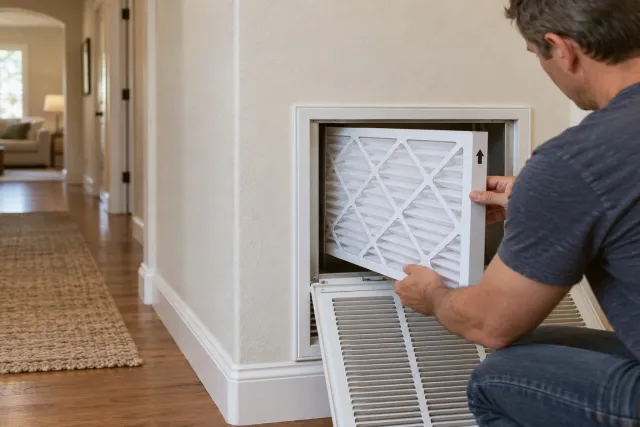
A badly clogged air filter restricts the air moving across the indoor coil. The system can still run, but it delivers less cool air, and in some cases the coil can get cold enough to freeze, which blocks airflow even more. If the filter looks grey and dusty, replace it. Make sure supply vents and the large return grilles are open and not blocked by furniture or curtains.
Look at the outdoor unit
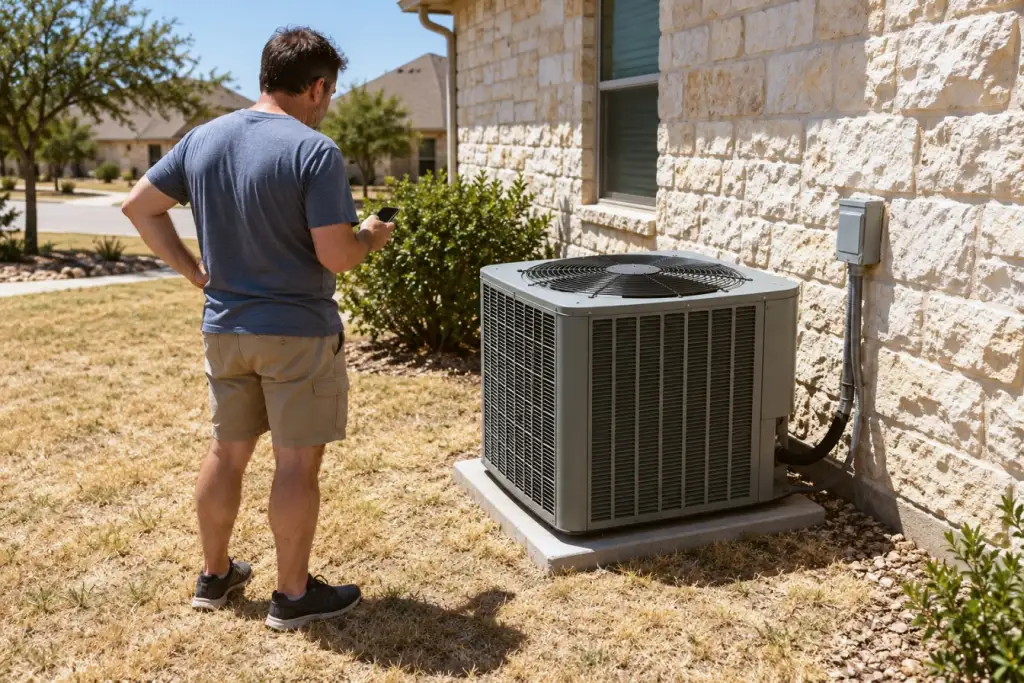
Go outside and look at the condenser while the system is calling for cooling. Two things are worth noticing:
- Is the fan on top spinning? If the unit is humming but the fan is not turning, or neither the fan nor the compressor is running, the cause is often an electrical part such as the capacitor or the contactor.
- Is the coil clear? Grass clippings, leaves, cottonwood fluff and plants pressed against the fins make it harder for the unit to release heat. Keep about two feet of space around it.
Also check the circuit breaker for the air conditioner and the outdoor disconnect box near the unit. If a breaker has tripped, you can reset it once. If it trips again, leave it off and call for service, because a repeated trip points to an electrical fault.
A system that is low on refrigerant has a leak. Refrigerant is not used up like fuel.
Ice on the lines or the coil
If you see frost or ice on the larger copper line at the outdoor unit, or water around the indoor unit as ice melts, switch the cooling off and let the system thaw, with the fan on if you like to speed it up. Running a frozen system can damage the compressor. Ice usually means restricted airflow (a dirty filter, a dirty indoor coil, a blower problem) or a low refrigerant charge.
Refrigerant: why “just topping it up” is not a fix
Air conditioners do not use up refrigerant. If the charge is low, there is a leak somewhere in the system. Adding refrigerant without finding the leak means the problem comes back. Under EPA rules, only certified technicians may purchase and handle most refrigerants. Many older systems use R-22, which has not been produced or imported in the United States since 2020, so a leak in an older system is often where the repair-or-replace conversation begins.

What a technician checks
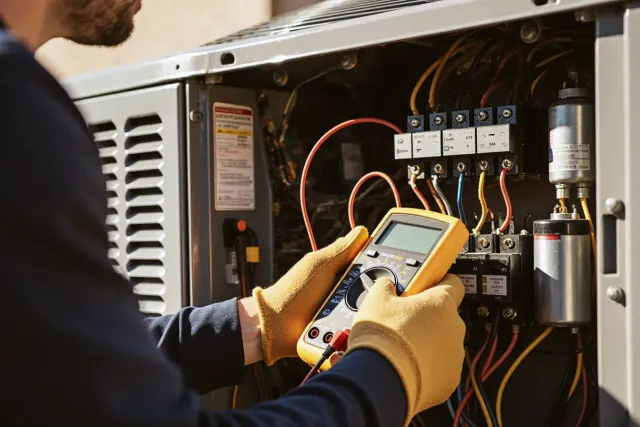
A repair visit for warm air usually follows the same order. The technician confirms the thermostat is calling for cooling and checks the electrical side of the outdoor unit: the capacitor against its rated value, the contactor, the fan motor and the wiring. Then come airflow (filter, blower, indoor coil) and the refrigerant side, with pressures and temperatures measured to see whether the charge is right and whether there are signs of a leak. The goal is to find the cause, not just the symptom.
When to stop and call
- The breaker trips again after one reset.
- You hear grinding, screeching or loud buzzing from the outdoor unit.
- You see ice, or water that keeps collecting near the indoor unit.
- You smell something burning. Switch the system off at the thermostat.
When you request service, describe what you have already checked. It saves time, and it helps the technician arrive with a better idea of where to start.
Common questions
Can a dirty outdoor coil really make the air warm?
Yes. The outdoor coil is where the heat taken out of your home is released. When the fins are covered in dirt, grass or fluff, the system cannot shed that heat as well, pressures rise, and the air delivered indoors is less cool. On very hot days a dirty coil can also make the system shut down on a safety control. Rinsing the coil gently with a garden hose, with the power off at the disconnect, is something many homeowners do; a technician can clean it more thoroughly during maintenance.
The system worked yesterday. Why would it suddenly blow warm air?
Sudden changes usually point to something that failed outright rather than something that wore down slowly: a capacitor, a contactor, a tripped breaker or a blown fuse at the disconnect. A refrigerant leak more often shows up gradually, with the house cooling a little less well each week. Telling the technician whether the change was sudden or gradual helps them start in the right place.
Is it safe to keep running the system while I wait for a visit?
If the outdoor unit is humming but the fan is not turning, or you see ice, switch the cooling off. Running the compressor without the fan, or with a frozen coil, can damage it. If the system is simply cooling less well than usual and nothing looks or sounds wrong, it is usually fine to keep it running at a comfortable setting until the visit. When in doubt, switch it off and describe what you saw.
Why does the air feel cool at some vents and warm at others?
That points to the ductwork rather than the equipment: a disconnected or crushed duct in the attic, or a long run to a far room. Our article on why some rooms stay hot covers this in more detail.
Related service
AC Repair
Help with warm air, uneven cooling, unusual noises, and systems that will not start.
More from the Journal
-
 Cooling
 Why some rooms stay hot: airflow and ductwork
When one or two rooms never cool like the rest of the house, the equipment is often not the problem. Sun, ductwork and return air usually are.
-
 Cooling
 Thermostat settings that make sense in a Texas summer
Small thermostat habits make a real difference over a long cooling season. Here is what the Department of Energy suggests, and a few things that do not work as people expect.
-
 Maintenance
 How often should you change your air filter in San Antonio?
There is no single right number of weeks. A long cooling season, pets, pollen and the type of filter all change the answer. The simplest rule: check it monthly and change it when it looks dirty.
Next step
Let’s make the next step clearer.
Tell us what your system is doing and what kind of help you need. Coverage and appointment details are confirmed after contact.